

Regardless of the industry, consumers are online and interacting in larger volumes. Social media marketers need to find better ways to serve and engage with these consumers more efficiently. From writing captions and composing posts to crafting creative copy for ads, Stories, Reels, and campaigns, social media marketers need to be able to do it all and do it well. There are many ways social media managers can use ChatGPT for their benefit. For starters, the AI-powered chatbot can help marketers produce content faster and more efficiently. Here are some of the best ways to use ChatGPT for social media marketing:
Content creation
Generate ideas and inspiration for social media posts, articles, blog content, or captions. You can provide ChatGPT with a topic or ask for suggestions to spark your creativity and develop unique content for your social media channels.
Prompt: Give me ideas of prompts for content creators on social media:
Answer:
- Generate X ideas for Instagram posts to promote a special offer.
- Write a post with the topic: [insert topic] and a key takeaway: [insert takeaway].
- Craft a post that drives traffic to my podcast about [topic].
- Create a quiz about [topic] to engage my audience.
- Generate a quote about [topic or sentiment here] to inspire my followers.
- Write an Instagram caption for a post about [theme] using the keyword ‘[add keyword]’ and three relevant hashtags.
- Generate X polls to gather opinions from my audience on [topic].
- Give me ideas for a social media post that combines [topic A] and [topic B].
- Provide Instagram story ideas to promote [offer] and increase engagement.
- Generate viral Reel ideas related to [topic] to captivate my audience.
- Compose a social media post to announce the launch of [product/service].
- Generate X headline options for an infographic on [topic] to grab attention.
- Craft a Twitter thread about [topic] using X tweets with a maximum of 280 characters each.
- Summarize an article [article link] for social media and spark interest among my followers.
- Create a social media strategy for a product launch. The product is [provide a brief description].
- Write an Instagram caption with a hook and call-to-action (CTA) to click the link in bio on [topic].
- Craft a post highlighting the benefits of [topic] to educate and engage my audience.
- Develop engaging social media content to promote [your website link] and drive traffic.
- Goal-Oriented Campaigns. Chat GPT can help you craft social media marketing campaigns per your goal. All you need to do is to provide the right inputs.
Prompt: Act like an experienced social media manager. Craft a social media marketing campaign to increase awareness of a brand named Shoes, which sells shoes for kids.
Answer:
As an experienced social media manager, I would design a social media marketing campaign to increase awareness of Shoes, a brand that sells shoes for kids. Here’s a step-by-step outline of the campaign:
- Define campaign objectives: The first step is to establish clear objectives for the campaign. In this case, the primary goal is to increase brand awareness for Shoes and its range of kids’ shoes.
- Identify target audience: Determine the specific target audience for the campaign, such as parents, caregivers, or individuals interested in children’s fashion. Understanding the audience will help tailor the content and messaging accordingly.
- Choose social media platforms: Select the social media platforms that align with the target audience and are suitable for showcasing visual content. Platforms like Instagram and Facebook tend to work well for fashion and lifestyle brands.
- Develop a campaign theme: Create a consistent theme that resonates with the target audience and showcases the brand’s unique selling points. For example, the campaign theme could be Step into Style: Shoes for Trendy Kids.
- Create engaging content: Develop visually appealing and informative content that highlights the brand’s products, such as high-quality images and videos featuring kids wearing Shoes’ shoes in different settings and activities. Emphasize the brand’s quality, comfort, and stylish designs.
- Utilize user-generated content (UGC): Encourage customers to share their photos and experiences with Shoes’ products by running a UGC campaign. Share and repost user-generated content that showcases happy kids wearing Shoes’ shoes, along with relevant hashtags.
- Collaborate with influencers: Partner with relevant parenting influencers or kid-centric accounts on social media to showcase Shoes’ products. Influencers can create authentic content, review the products, and promote them to their engaged audience.
- Run contests and giveaways: Organize contests or giveaways that encourage audience participation. For instance, ask parents to share their favorite Shoe styles or share pictures of their kids wearing Shoes’ shoes for a chance to win a prize. This generates engagement and spreads awareness.
- Leverage storytelling: Share engaging stories that revolve around the brand’s values, craftsmanship, and the positive impact of wearing Shoes’ shoes on children’s comfort and style. This helps create an emotional connection with the audience.
- Engage with the audience: Respond promptly to comments, messages, and mentions on social media platforms. Engage in conversations, answer queries, and show appreciation for customer feedback. This builds trust and loyalty among the audience.
- Monitor and analyze performance: Regularly monitor campaign performance using social media analytics tools. Track metrics such as reach, engagement, website traffic, and conversions. Use the insights gained to optimize the campaign and make data-driven decisions.
- Collaborate with complementary brands: Partner with other kid-centric brands or organizations to cross-promote each other’s products or services. This can include joint giveaways, co-branded content, or influencer collaborations, further expanding the brand’s reach.
Remember to maintain a consistent brand voice, tone, and visual style throughout the campaign. Adjust and refine the strategy as needed based on the campaign’s performance and audience feedback. By implementing this comprehensive social media marketing campaign, Shoes can effectively increase awareness, engage with its target audience, and establish a strong presence in the kids’ shoe market.
Trend identification
Ask ChatGPT to identify emerging trends and popular topics within your industry or niche. This can help you stay ahead of the curve and create content that resonates with your target audience.
Prompt: Identify emerging trends in social media
Answer: Here are some emerging trends in the social media landscape:
- Short-Form Video: Short-form video content is on the rise, with platforms like TikTok and Instagram Reels gaining popularity. This trend emphasizes the importance of bite-sized, engaging video content that captures attention quickly.
- Live Streaming: Live streaming has become increasingly prevalent on social media platforms. It enables real-time interaction with audiences, fosters authenticity, and provides opportunities for brands and content creators to engage with their followers in a more immediate and interactive manner.
- Ephemeral Content: Ephemeral content, such as Instagram Stories and Snapchat Snaps, has gained traction. This type of content disappears after a short period, creating a sense of urgency and encouraging users to engage with it quickly.
- Social Commerce: The integration of e-commerce and social media has grown significantly. Social media platforms are expanding their shopping features, allowing users to discover and purchase products directly within the app, blurring the lines between social media and online shopping.
- Influencer Marketing Evolution: Influencer marketing continues to be a prominent trend, but it has evolved beyond traditional sponsored posts. Brands are now focusing on long-term partnerships, micro-influencers, and authentic collaborations to build trust and connect with niche audiences.
- Authenticity and Transparency: Social media users are increasingly demanding authenticity and transparency from brands and content creators. Genuine, relatable content that showcases real experiences and values resonates more with audiences.
- Social Causes and Activism: Social media has become a powerful tool for raising awareness about social issues and promoting activism. Users expect brands to take a stand on important topics and use their platforms for social good.
- Personalization and Customization: Social media platforms are enhancing personalization features, allowing users to curate their feeds and receive content tailored to their interests. Brands that deliver personalized experiences and highly targeted content have a competitive advantage.
- Augmented Reality (AR) Filters: AR filters and effects on platforms like Instagram and Snapchat are gaining popularity. Users enjoy engaging with AR experiences, whether for entertainment, branding, or product demonstrations.
- Privacy and Data Protection: With increasing concerns about data privacy, users are becoming more conscious of their online privacy and data security. Social media platforms are facing pressure to prioritize user privacy and provide more transparent data handling practices.
- Respond to Comments: You can use ChatGPT to quickly respond to comments on your social media posts using the following prompt:
Prompt: Write a response to Mr. Foles who commented „That´s great! I´m so excited!“ on social media post: „This new product is in Iceland Foods stores from today.“
Answer: Hi Mr. Foles! Thank you for your enthusiastic comment! We’re thrilled to hear that you’re excited about our new product. It’s now available in Iceland Foods stores starting today, so you can head over and grab it for yourself. We hope you enjoy the product and have a great experience with it. If you have any questions or need further assistance, feel free to reach out. Happy shopping!
Create A Content Calendar
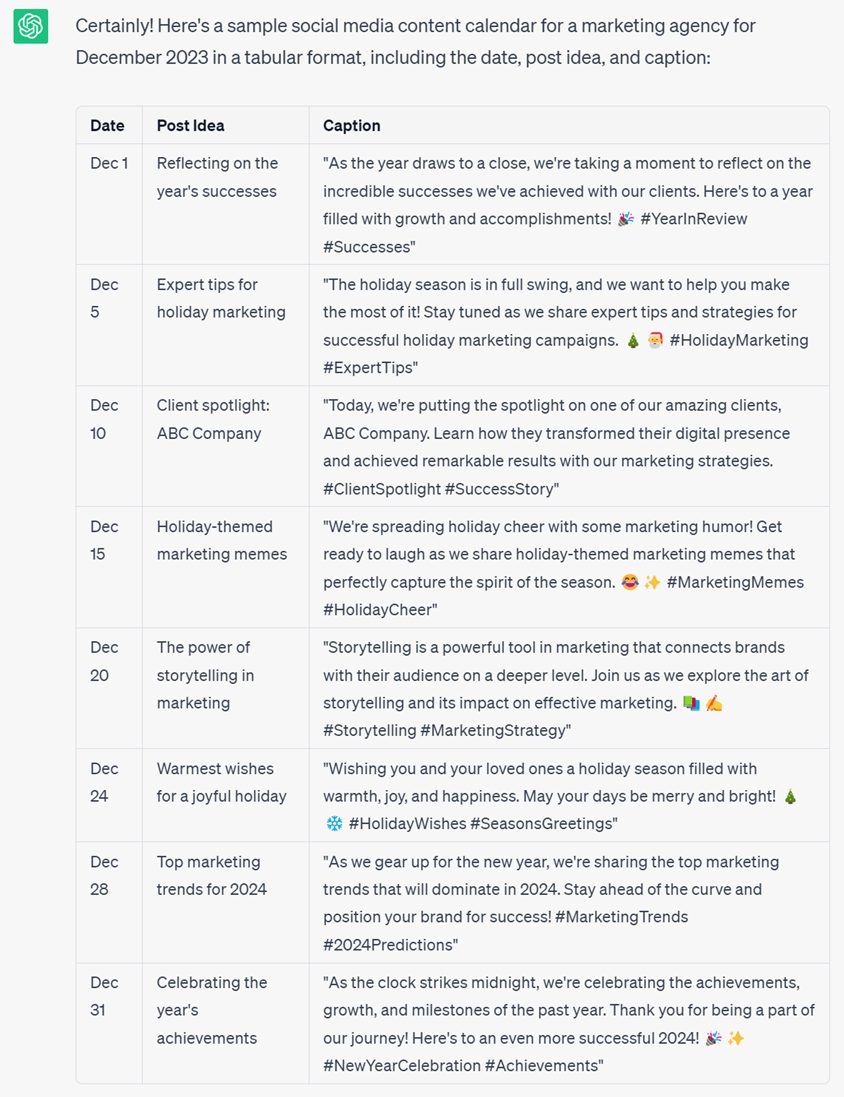
Creating a diary or calendar is important for role-based prompts in marketing and any business area. In marketing, creating content calendars is critical to planning how much content will be created, what it will be about, and when it will be posted.
Prompt: Create a social media content calendar for a marketing agency. I want the calendar for December 2023 in a tabular format, including the date, post idea, and caption.
Answer:
Other uses
Influencer research
ChatGPT can assist in identifying potential influencers or micro-influencers relevant to your brand. By analyzing social media data and engagement metrics, ChatGPT can provide insights into influencers who align with your brand values and have a genuine following.
Ad copywriting
Generate compelling ad copy for your social media advertising campaigns using ChatGPT. By providing key information and specifications, you can ask ChatGPT to draft a persuasive copy that grabs attention and drives conversions.
Conclusion
By harnessing the capabilities of ChatGPT, social media marketers can enhance their efficiency, creativity, and overall effectiveness in engaging with their target audience, ultimately driving better results for their brands in the competitive digital landscape.