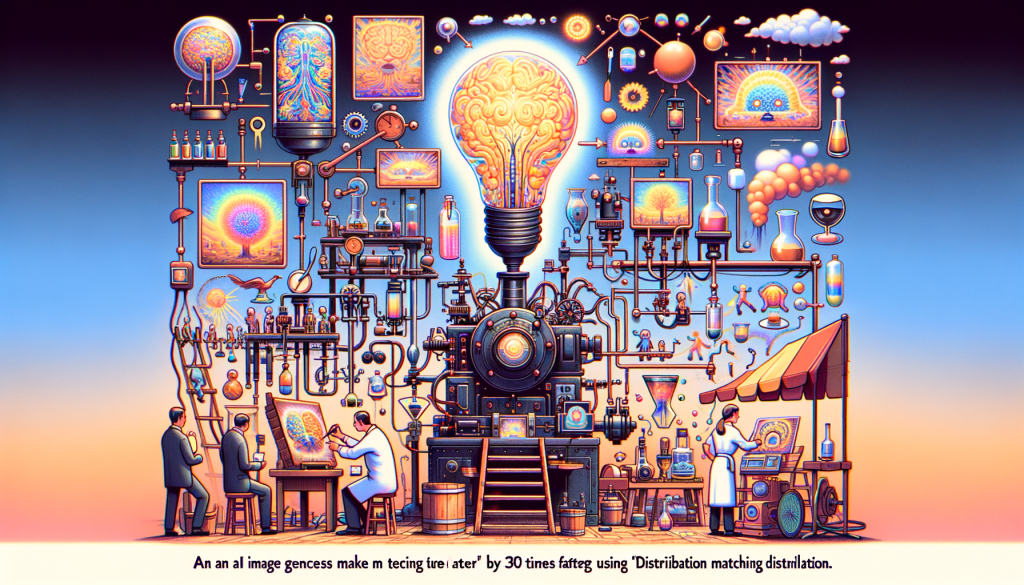
MIT scientists have developed a technique called “distribution matching distillation” (DMD) that accelerates popular AI image generators by condensing a 100-stage process into one step. This method results in smaller and faster AI models while maintaining image quality. The new approach reduces computational time by 30 times and retains or surpasses the quality of the generated visual content. Diffusion models, such as DALL·E 3 and Stable Diffusion, are taught to new AI models using DMD. These models generate images by encoding random images with noise and then clearing up the noise through a multi-stage process. By applying DMD to a new model, the scientists reduced image-generation time from 2.59 seconds to 90 milliseconds, making it 28.8 times faster. DMD consists of two components: “regression loss,” which organizes images based on similarity, and “distribution matching loss,” which minimizes the outlandishness of the generated images. This breakthrough dramatically reduces computational power and accelerates the image generation process, making it advantageous for industries requiring quick and efficient content creation.