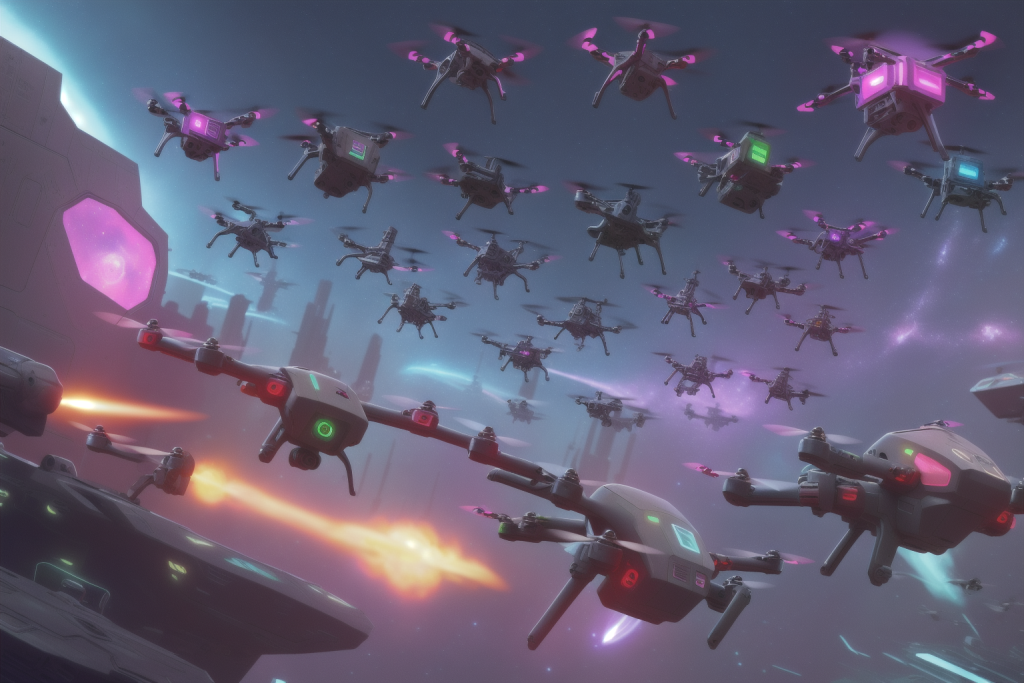
In the annals of history, warfare has often been the crucible for technological innovation, and today we stand on the precipice of a revolution unlike any other. The age of autonomous warfare is no longer a figment of science fiction; it’s an impending reality. As geopolitical tensions simmer globally, defense innovators are turning to one of nature’s most efficient strategies: the swarm. Imagine the battlefield buzzing not with bullets and shouts, but with the coordinated hum of drone swarms – fleets of autonomous machines operating not as singular entities, but as unified collectives with a shared consciousness. This is not the warfare of our ancestors or even our predecessors; this is a new kind of conflict, defined by technology that mimics the collective intelligence of swarms found in nature. As we delve into the intricacies of swarm intelligence, we must ask: are we prepared for a future where wars are waged not by humans, but by drones that think, decide, and adapt en masse?
Table of Contents
- Introduction to Swarm Intelligence in Drones
- Fundamentals of Distributed Algorithms
- Leader Election Problem
- Real-time Consensus in Dynamic Environments
- Swarm Intelligence Algorithms and Natural Mimicry
- Flocking Behavior and Decentralized Control
- Decentralized Decision-making in Adversarial Conditions
- Communication Protocols and Information Reliability
- Redundancy and Failure Recovery Mechanisms
- Future of Swarm Intelligence and Autonomous Coordination
- Conclusion
- Further Reading and References
Introduction to Swarm Intelligence in Drones
Question: “For our readers diving into the complexities of autonomous systems, can you distill the essence of swarm intelligence within drone technology? There’s a fascination with how these individual units come together to mimic some of the most captivating phenomena in nature.”
Answer: “Absolutely, it’s a topic that is as intriguing as it is complex. At its core, swarm intelligence in drones represents a paradigm shift from centralized, top-down control to decentralized, bottom-up cooperation. Imagine a bird flock, where no single bird is in charge, yet they move in astonishing harmony. This natural spectacle isn’t choreographed by any leader, but rather emerges from simple rules followed by each bird, dictating how to align with neighbors, avoid collisions, and stay close to the group.
Now, apply this concept to drones. Each drone is akin to a bird in the flock, operating on local information — what it ‘sees’ around it — rather than instructions from a central command. They communicate with nearby drones, reacting dynamically to changes within their immediate vicinity, which, on a larger scale, leads to the ‘intelligent’ behavior of the swarm. This is the crux of swarm intelligence — simple, local actions leading to collective, intelligent outcomes.
This approach is vital for several reasons. In potentially hostile or unpredictable environments, centralized control can be a liability. If the controlling unit is disabled, the entire system fails. However, in a decentralized swarm, there’s no single point of failure. Each drone operates autonomously, making real-time decisions based on its surroundings and interactions with others. This confers remarkable adaptability and fault tolerance, essential for coordinated functions, whether it’s search and rescue missions, synchronized aerial displays, or strategic applications.
Moreover, swarm intelligence allows these systems to undertake complex tasks beyond the capabilities of individual units, leveraging the ‘power of the collective.’ For example, while a single drone might struggle to map a large, hazardous area, a swarm can cover the same ground quickly and efficiently, combining their data to create a comprehensive map.
In essence, we’re not just programming individual drones; we’re orchestrating a symphony of interactions that give rise to this larger, intelligent ‘organism.’ It’s this blend of autonomy, coordination, and emergent behavior that makes swarm intelligence not just a powerful asset but a fascinating field within AI and robotics.”
Fundamentals of Distributed Algorithms
Question: “Your insights into swarm intelligence have certainly laid a fascinating groundwork. Building on that, our technically savvy readers would be eager to understand the mechanics behind this intelligence. Could you elaborate on how basic distributed algorithms fit into the picture and their necessity for the seamless operation of these drone swarms?”
Answer: “Of course, I’d be happy to demystify that aspect. Distributed algorithms are the beating heart of any swarm-based system. They provide the rules and mechanisms that allow our swarm of drones, each with its own processing unit, to operate in a cohesive manner without central oversight. It’s like giving each drone a small piece of the puzzle, and through their interactions, they come together to reveal the whole picture.
Now, why are these algorithms indispensable? Firstly, they facilitate consistent communication. Drones need to exchange information about their state, such as position, speed, or battery life, with their peers. Distributed algorithms help manage these communications efficiently, ensuring drones can send, receive, and process messages within minimal delay, which is crucial in environments where reaction time is critical.
Secondly, these algorithms enable collective decision-making. Unlike a central system dictating every move, each drone makes its own decisions based on locally available information. For instance, when drones are on a reconnaissance mission, they need to decide in real-time how to cover the area comprehensively. Here, a distributed algorithm would allow them to coordinate their movements, ensuring they avoid overlaps and gaps without needing a ‘command center.’
One of the simplest forms of distributed algorithms is the consensus algorithm. Imagine if several drones come across an obstacle. They need to agree on how to navigate around it. The consensus algorithm helps all drones arrive at a common decision on how to proceed, even if some drones have conflicting information.
Furthermore, we have synchronization algorithms — essential for operations requiring high precision. These algorithms ensure that all drones act simultaneously or with accurately timed delays. For example, if a swarm needs to pass through multiple points in a synchronized fashion, perhaps for a coordinated surveillance sweep, these algorithms keep the drones on beat, much like a conductor with an orchestra.
The beauty here lies in the resilience of the system. If a few drones encounter issues, the algorithms allow the swarm to ‘readjust’ seamlessly. The remaining units collaborate to fill in any operational gaps, maintaining the integrity of the mission.”
Leader Election Problem
Question: “The seamless autonomy of drone swarms you’ve described is truly fascinating, and it naturally leads us to ponder about leadership within these collectives. Our readers are curious about scenarios where a leader is necessary amidst this autonomy. Could you delve into the complexities of ‘Leader Election’ and how algorithms manage this sophisticated task?”
Answer: “That’s an excellent segue into one of the most nuanced aspects of swarm dynamics. While the beauty of drone swarms lies in their collective autonomy, there are instances where a leader – a single point of coordination and decision-making – becomes necessary, especially for tasks requiring unified strategy or synchronized maneuvers.
However, electing a leader in a dynamic, constantly shifting environment is far from trivial. The ‘Leader Election’ process faces challenges such as the unpredictable nature of drones’ operational status, communication delays or interruptions, and the necessity for quick adaptation when a leader drone malfunctions or is destroyed.
Enter the realm of specific algorithms designed to elegantly solve this problem. Let’s talk about the ‘Bully’ and ‘Ring’ algorithms, two of the classical approaches in distributed systems.
The ‘Bully’ algorithm takes a rather aggressive approach. Here, when a drone initiates the election process, perhaps after detecting the leader’s failure, it ‘bullies’ its way to leadership by claiming superiority based on a predefined criterion, often its unique identifier. It challenges all other drones with higher identifiers, essentially saying, ‘I’m the candidate unless you can prove you’re more qualified.’ If there’s no response, the drone assumes leadership. However, if a higher-ranking drone is operational, it takes charge of the election, and the process continues until the ‘biggest bully’ takes over. It’s efficient in scenarios where there’s a clear hierarchy of command or priority among drones.
On the other hand, the ‘Ring’ algorithm is more democratic and orderly. Drones are logically organized into a closed loop, regardless of their physical locations. During the election, a message circulates around the ring, and each drone appends its identifier. When the message completes the loop, the drone with the highest identifier in the list assumes leadership. This method, while more methodical and less aggressive, requires reliable and uninterrupted communication, making it susceptible to network failures or delays.
Both algorithms have their strengths and drawbacks, and their suitability hinges on the specific operational parameters and objectives of the drone swarm. They lay foundational governance, ensuring there’s always a ‘captain’ in the ever-shifting environment the drones navigate, maintaining order within the inherent chaos.
In this intricate dance of autonomy and control, these algorithms ensure that the swarm can dynamically rally under a new leader, adapting to ever-evolving scenarios and continuing their mission with minimal disruption. It’s this balance between collective intelligence and hierarchical decision-making that enables drone swarms to operate efficiently across diverse and challenging tasks.”
Real-time Consensus in Dynamic Environments
Question: “The intricacies of electing a leader within a swarm are indeed fascinating and bring us to another compelling facet of swarm decision-making. Given the volatile environments these drone swarms operate in, making unanimous decisions in real-time is crucial. Could you enlighten us on how consensus algorithms, particularly Paxos or Raft, come into play here?”
Answer: “Absolutely, this is where we venture into the critical mechanics of ‘agreement’ among our autonomous agents in the swarm. Consensus algorithms are pivotal in scenarios where every drone in the swarm needs to agree on a certain course of action, ensuring that despite individual opinions, there is a common ground of decision that every unit adheres to. This uniformity is crucial for maintaining the integrity and purpose of the mission, especially in unpredictable conditions.
Paxos and Raft are two heavyweight consensus algorithms in this arena, each with its unique approach to forging agreement amidst potential chaos.
Paxos, one of the oldest in the book, is renowned for its resilience and fault tolerance. It operates on the principle of majority agreement and involves several rounds of proposals and acceptances. In the context of drone swarms, imagine a scenario where drones need to agree on which area to scout first. One drone proposes a strategy, and the others vote. If a majority agrees, that becomes the ‘law of the land.’ If not, a new proposal is made, and the process repeats until consensus is reached. The resilience here is that as long as a majority of drones can communicate, a consensus can be reached, even if some drones are lost or communication links fail.
However, Paxos is notoriously complex and can be overkill for situations where simpler, more direct communication is feasible. This is where Raft comes in. Raft simplifies the consensus process by electing a leader for decision-making and then replicating the leader’s decisions to other members. The drones only communicate with the leader, which then broadcasts the agreed decision. This reduces the communication overhead and streamlines the decision-making process, essential when quick adaptation to changing environments is critical.
But why are these algorithms so important? In unpredictable terrains or hostile environments, drones face communication disruptions, physical obstacles, or unexpected threats. A robust consensus mechanism ensures that all drones are ‘on the same page,’ preventing disjointed behavior that could jeopardize the mission. If a decision is made, it’s crucial that it is acknowledged and executed uniformly across the swarm, whether it’s evading a threat, re-routing based on new information, or executing a coordinated maneuver.
Paxos and Raft are the ‘negotiators’ in the drone world, ensuring harmony and unified purpose within the group, safeguarding the mission against the unpredictability of their operational theatres. They are the silent enforcers of democracy in a world of autonomous agents.”
Swarm Intelligence Algorithms and Natural Mimicry
Question: “The harmony within drone swarms, their consensus-driven decisions, and unified purpose are indeed thought-provoking. It seems nature has been a great teacher in this regard. Our readers are intrigued by how swarm intelligence mirrors the natural world. Could you expand on how algorithms like Particle Swarm Optimization and Ant Colony Optimization draw inspiration from nature, particularly regarding pathfinding and optimization tasks?”
Answer: “Certainly, it’s one of the aspects of swarm intelligence that is most striking. Nature has been perfecting its algorithms for millions of years, and we’ve just started to uncover these secrets. Both Particle Swarm Optimization (PSO) and Ant Colony Optimization (ACO) are fascinating examples of how observing natural behaviors can lead to breakthroughs in computational intelligence.
Starting with PSO, this algorithm is inspired directly by the social behavior of bird flocking and fish schooling. Imagine a swarm of drones facing a complex environment, with the task of searching for the optimal path through it. In PSO, each drone represents a ‘particle’ that explores the search space. These particles adjust their trajectories based on their own experiences and the ‘stories’ of success from other members of the swarm.
Each drone is ‘attracted’ to the position where it found the best solution (food source, in nature’s terms) and where the swarm, collectively, has found the best solution. It’s a beautiful dance, balancing self-interest and collective welfare, leading to a rapid honing in on the optimal solution. The advantage? PSO can navigate complex, multidimensional spaces more efficiently than a drone relying solely on its own experience, making it perfect for tasks like optimal route planning, resource allocation, or even crash recovery scenarios.
Now, ACO takes a page from our industrious ant friends. It’s fascinating how ants, seemingly aimless, find the shortest path to a food source. They lay down pheromones, creating a scent trail. The more ants follow a path, the stronger the scent, leading others to follow suit. In a drone scenario, imagine each drone ‘laying down’ a digital pheromone along its path. Drones exploring a disaster area could ‘mark’ their routes, with the most efficient paths becoming more ‘popular,’ guiding subsequent drones.
The real magic happens when these paths start to evaporate, just like pheromones do. This avoids the perpetuation of suboptimal paths and encourages constant exploration and adaptation. For drones, this means more robust pathfinding, especially in changing environments, and better resource distribution – for instance, during a search and rescue mission where time is of the essence.
What we’re witnessing here is a computational homage to nature’s genius. By emulating biological processes, these algorithms provide drone swarms with remarkable adaptability, robustness, and efficiency, allowing them to tackle challenges that would be insurmountable for individual, isolated systems. It’s a testament to the idea that often, nature knows best.”
Flocking Behavior and Decentralized Control
Question: “The way swarm intelligence algorithms emulate nature’s efficiencies is truly a blend of simplicity and complexity. Speaking of natural phenomena, many of our readers are fascinated by the ‘Boids’ model, known for simulating the flocking behavior of birds. Could you delve into how this model operates within drone swarms and how it enhances their autonomy and adaptability?”
Answer: “Absolutely, the ‘Boids’ model is a classic example of how mimicking simple natural behaviors can lead to the emergence of complex and intelligent systems. Created by Craig Reynolds in 1986, ‘Boids’ is essentially a computer simulation that replicates the flocking of birds, and it’s based on three fundamental rules that govern the behavior of each individual agent, or in our context, each drone.
- Separation: Avoid crowding your neighbors. Each drone maintains a safe distance from its neighbors to prevent collisions. This is akin to personal space in human terms.
- Alignment: Steer towards the average heading of your neighbors. Drones align their direction with the drones in their vicinity, promoting uniform movement as a cohesive unit. It’s the ‘follow the crowd’ mentality that keeps the swarm moving harmoniously.
- Cohesion: Move towards the average position of your neighbors, but not too aggressively. This rule prevents the drones from dispersing, maintaining the integrity of the swarm.
Now, why is this simplicity so powerful? Because it facilitates decentralized control, crucial for real-world applications of drone technology. In a decentralized system, there’s no single point of failure. If one drone malfunctions, the rest of the swarm can continue the operation unaffected, as opposed to centralized systems where the failure of the controlling unit cripples the entire operation.
Moreover, ‘Boids’-governed swarms are highly adaptable. They can scale seamlessly, allowing for the addition or subtraction of drones without disrupting the system’s functioning. They’re capable of navigating through complex and dynamic environments efficiently, as the basic rules account for sudden obstacles or changes within the environment. For instance, if a drone detects an obstacle, it alters its path, and the neighboring drones adjust accordingly, all in real-time, maintaining the flow and purpose of the mission.
Furthermore, this model empowers drones to make decisions autonomously, based on their local perceptions, which is vital in scenarios where rapid response is critical, and relying on distant control centers is impractical. This autonomy extends to forming shapes, splitting into subgroups to cover more area, or even ‘herding’ in response to external stimuli, all without specific instructions, but rather through local interactions and the inherent logic of the ‘Boids’ rules.
The ‘Boids’ model encapsulates the principle of ’emergent behavior’ — where simple interactions give rise to complex actions, a foundational concept in swarm intelligence. It’s not just about programming drones to complete a task but instilling them with the instincts to navigate the complexities of real environments. They become not just tools but entities capable of ‘understanding’ their surroundings and reacting in the most efficient way, much like a flock of birds navigating the vast skies.”
Decentralized Decision-making in Adversarial Conditions
Question: “The ‘Boids’ model and its implications for decentralized control are indeed profound, highlighting the elegance of simplicity in complex systems. Shifting gears slightly, our readers are interested in understanding the decision-making frameworks that govern these autonomous entities, especially under uncertainty. Could you explain how Markov Decision Processes and their decentralized extensions operate in such contexts?”
Answer: “Certainly, this is where we delve into the cognitive backbone of autonomous decision-making. Markov Decision Processes (MDPs) and their more sophisticated siblings, Decentralized Partially Observable MDPs (Dec-POMDPs), are critical for enabling drones to make informed decisions in environments where elements of uncertainty and unpredictability are at play.
MDPs provide a mathematical framework for decision-making, where an agent (in our case, a drone) is faced with a set of states and actions, with the goal of performing actions that maximize some notion of cumulative reward. The beauty of MDPs lies in their ‘memoryless’ property, meaning that the decision for the next action depends solely on the current state, not on the sequence of events that preceded it. This makes MDPs incredibly powerful for real-time decision-making, where a drone’s immediate response can be the difference between mission success and failure.
However, real-world scenarios often have information asymmetry, where a drone doesn’t have complete visibility into the ‘state’ of the environment. Imagine a reconnaissance mission in hostile territory, where environmental conditions are obscured or adversaries are concealed. Here, Dec-POMDPs come into play, extending the MDP framework to scenarios where the state of the system is not fully observable and decisions are made based on probabilistic inferences. Additionally, in Dec-POMDPs, multiple agents (drones) need to act in concert, but they cannot share their state information fully or reliably due to distance, interference, or deliberate jamming.
Under Dec-POMDPs, each drone maintains a belief about the state of the world based on its observations and uses this belief to make decisions. They must also factor in the uncertainty over other drones’ beliefs and actions. This is crucial in adversarial environments, where reacting to threats or changing conditions requires not just understanding one’s surroundings, but also predicting the actions of fellow drones.
For instance, if a drone identifies a threat, it doesn’t just evade; it considers the probability of other drones encountering the same threat and adjusts its strategy, balancing its safety, mission objectives, and the welfare of the swarm. It’s a complex dance of prediction, adaptation, and decision-making, all happening in real-time.
The power of MDPs and Dec-POMDPs lies in their ability to provide a structured approach to decision-making under uncertainty, allowing drones to assess risk, predict outcomes, and make decisions that optimize for the overall mission success, even when they have limited information and communication. These processes form the bedrock of strategic autonomy, enabling drone swarms to operate cohesively in complex, unpredictable, and even hostile environments.”
Communication Protocols and Information Reliability
Question: “The strategic autonomy facilitated by MDPs and Dec-POMDPs certainly underscores the sophistication of these systems. Now, for these frameworks to function effectively, drones must communicate with one another. Our readers are curious about the nitty-gritty of inter-drone communication, especially in scenarios susceptible to interference or jamming. Could you elaborate on the protocols ensuring data integrity and timeliness in such challenging conditions?”
Answer: “Absolutely, inter-drone communication is the lifeline of swarm intelligence. Without robust communication protocols, the sophisticated decision-making frameworks we discussed would be ineffective. In the realm of drone swarms, we’re primarily dealing with wireless communication systems, which, while incredibly versatile, are susceptible to various forms of interference, including deliberate jamming in adversarial environments.
One of the key protocols employed in drone communications is a derivative of the Mobile Ad-hoc Network (MANET) protocols, specifically tailored for Unmanned Aerial Vehicles (UAVs) — often referred to as FANET (Flying Ad-hoc NETwork). These protocols are designed for networks where there is no fixed infrastructure, and nodes (in this case, drones) are constantly moving, much like soldiers in a battlefield.
FANETs employ several strategies to maintain data integrity and timeliness. One such strategy is ‘frequency-hopping.’ Drones rapidly switch among many frequency channels according to a predefined sequence shared within the swarm. This makes jamming difficult because the attacker must jam a wide spectrum of frequencies to disrupt the communication effectively, thus requiring more resources and energy.
Another crucial strategy is ‘packet redundancy.’ Drones send multiple copies of the same information to ensure that at least one copy reaches its destination, combating data loss due to unreliable connections or intentional jamming.
Now, let’s talk about ‘mesh networking,’ where each drone acts as a transmitter and receiver, creating a network of interconnected nodes. If one drone fails or its signal is jammed, the data packets are automatically rerouted through other drones, ensuring the network’s resilience and continuity of communication.
In terms of maintaining timeliness, ‘real-time transport protocols’ come into play. These are designed to prioritize the transmission of time-sensitive data, even in congested networks, ensuring that critical information (like positional data or emergency alerts) is communicated with minimal delay.
Furthermore, in highly sensitive scenarios, drones employ ‘cognitive radio’ capabilities. Here, drones can detect unused frequency bands (white spaces), assess the communication landscape, and adapt by changing their transmission or reception parameters for optimal communication. This is particularly useful in jamming scenarios as it allows drones to avoid interfered frequencies dynamically.
The synergy between these protocols and strategies is what keeps the swarm’s communication resilient, timely, and integral. They form an invisible web of connectivity, ensuring that each drone, regardless of the environmental challenges, remains a functional piece of a larger, cohesive unit, capable of executing complex missions in synchronized harmony.”
Redundancy and Failure Recovery Mechanisms
Question: “The robustness of communication protocols in drone swarms certainly highlights the advanced thinking in this field. However, no system is immune to failures. Our readers are keen to understand what happens when individual drones fail or are destroyed. Could you explore the redundancy or recovery algorithms that kick in to preserve the swarm’s functionality?”
Answer: “Indeed, the reality of operating in complex environments is that failures are not just possible; they’re expected. This is where the concept of swarm robustness comes into play, ensuring that the collective can withstand individual disruptions. The algorithms and strategies employed for this purpose are as fascinating as they are vital.
First, let’s talk about ‘fault detection and isolation’ mechanisms. These are the ‘sentries’ of the swarm, continuously monitoring the operational status of each drone. They assess parameters like battery levels, engine performance, and communication activity. When a drone starts to fail or behaves anomalously — perhaps due to damage or a system error — these mechanisms quickly isolate it, preventing potential malfunctions from affecting the others.
Once a fault is detected, ‘redundancy algorithms’ take the stage. These aren’t redundancy in the traditional sense of backup systems but rather in the flexibility of roles within the swarm. Drones are typically homogeneous, meaning they share the same capabilities. If one drone fails, others can fill in for its role, ensuring the completion of the mission. This is known as ‘functional redundancy.’
For instance, in a surveillance mission, if one drone fails, others nearby can recalibrate their positions to cover the gap, often using algorithms inspired by nature, such as the aforementioned ‘Boids’ model. They maintain the formation and continue the task with minimal disruption, thanks to real-time communication and coordination.
In scenarios where significant portions of the swarm are compromised, ‘recovery algorithms’ become critical. These algorithms reorganize the operational structure of the swarm. For example, if a subgroup of drones is lost, the remaining units might reconfigure into smaller subgroups, focusing on critical tasks while abandoning lower-priority objectives. This kind of dynamic task reallocation ensures that the most important aspects of the mission continue.
Moreover, ‘self-healing algorithms’ enable the swarm to recover from internal disruptions. These can include forming new communication links to replace lost ones, or in more advanced setups, deploying repair drones that can physically fix damaged comrades in the field.
The crux of these systems is the concept of ‘distributed robustness.’ Unlike traditional systems that rely on hefty backups and fail-safes, drone swarms are designed to embrace failure, absorb it, and continue functioning. The loss of individual units, while detrimental, is not catastrophic. It’s this collective resilience that allows drone swarms to be deployed in some of the most challenging environments, from raging wildfires to conflict zones.
In essence, through continuous adaptation, role flexibility, and real-time coordination, drone swarms can withstand and recover from internal and external shocks, highlighting the profound strength found in unity and adaptability.”
Future of Swarm Intelligence and Autonomous Coordination
Question: “The resilience and adaptability of drone swarms you’ve outlined indeed resonate with the cutting-edge of technological evolution. Looking forward, our readers, seasoned in the current landscape of AI and robotics, are eager to glimpse what the horizon holds. How do you foresee the advancement of algorithms and technologies refining the capabilities of these autonomous collectives, especially concerning learning, adaptation, and perhaps the intriguing concept of cross-swarm coordination?”
Answer: “Peering into the future of swarm intelligence, we’re on the cusp of a transformative era. The evolution of algorithms and underlying technologies is set to catapult the autonomy, cognitive agility, and cooperative capabilities of drone swarms to unprecedented heights.
One significant frontier is the incorporation of advanced machine learning and artificial intelligence algorithms, enabling swarms to engage in ‘collective learning.’ Imagine drones that can learn from their environment and experiences, sharing this knowledge with the swarm, refining operational strategies, optimizing task execution, and innovatively responding to new scenarios. This evolution will see swarms that are not just executors of tasks but thinkers and innovators, capable of strategic planning and collective problem-solving.
Adaptation will take a quantum leap forward with the integration of ‘evolutionary algorithms.’ These algorithms simulate natural selection, enabling the swarm to continually evolve and adapt to dynamic environments. For instance, in fluctuating weather conditions, drones could autonomously adjust their aerodynamic configurations, communication protocols, or energy consumption strategies to maintain optimal performance. They’ll be capable of ‘genetic’ adaptations to their operational ‘DNA,’ enhancing survival and efficiency.
Now, let’s venture into the realm of ‘cross-swarm coordination,’ which promises to revolutionize how we perceive operational scalability and complexity. We’re talking about multiple swarms, each with its specialized functions, communicating, and working together. For example, during disaster relief efforts, one swarm could be tasked with reconnaissance, another with logistics, and yet another with search and rescue. These swarms could coordinate their efforts, sharing intelligence and resources, and making collaborative decisions that optimize the overall mission’s success.
This inter-swarm collaboration will be facilitated by advancements in ‘federated learning’ and ‘blockchain’ technologies. Federated learning will allow drones from different swarms to learn from each other while maintaining data privacy, whereas blockchain will enable secure, transparent, and tamper-proof communication. Imagine the synergy of multiple swarms, each learning from the experiences of others, all contributing to a global ‘hive mind’ of shared intelligence.
Furthermore, as we integrate more robust ‘quantum computing’ capabilities, we’ll witness a surge in computational power that will exponentially accelerate data processing, real-time analytics, and decision-making processes within and across drone swarms.
The future of drone swarms is one of intellectual autonomy, fluid adaptability, and collaborative intelligence, transcending individual capabilities and transforming how we approach exploration, disaster response, environmental conservation, and even space exploration. We’re not just designing machines; we’re nurturing a sophisticated digital ecosystem that mirrors the intellectual and cooperative complexities found in nature, driven by a relentless pursuit of innovation and enhancement.”
Conclusion
As we’ve journeyed through the complex algorithms and adaptive behaviors of drone swarms, one truth emerges starkly: the face of warfare is evolving. These autonomous collectives, inspired by nature’s millennia of evolutionary strategy, bring both apprehension and awe. They promise a conflict where human casualty on the battlefield could be significantly reduced, yet they also pose new ethical dilemmas and risks of unprecedented technological clashes. The silent, synchronized dance of drone swarms across our skies might be a harbinger of a new era, where our adversaries are not the soldiers across the border but the algorithms powering autonomous fleets. This shift compels us to rethink not just military strategy, but our ethical framework for the future of combat. As swarm intelligence continues to advance, it doesn’t just change how wars are fought; it transforms the very essence of conflict itself. In this looming age of autonomous warfare, we must brace for a world where the drones become the warriors, and human generals orchestrate battles from screens, guiding not individuals, but a formidable hive-minded force.
Further Reading and References
- “Swarm Intelligence in Autonomous Drone Navigation: Advances and Implications,” Nature Electronics, 2020. Available at: Nature Electronics Article
- “Swarms at War: Chinese Advances in Swarm Intelligence,” China Brief, The Jamestown Foundation, 2017. Available at: China Brief Article
- “Project Maven to Deploy Computer Algorithms to War Zone by Year’s End,” U.S. Department of Defense, 2017. Available at: DoD News
- “The Next Arms Race: Autonomous Drone Warfare,” The National Interest, 2019. Available at: National Interest Article
- “Autonomous Weapons and Operational Risk,” Center for a New American Security, 2016. Available at: CNAS Report